Menopause is a significant milestone in women’s lives – a complex interplay of hormones, bodily systems, and emotions. It is time for us to know exactly what’s behind it, and why it’s a milestone that we can all accept and embrace.

How many of us were sat down in our 30s and told all about menopause and what we should expect? Yea, me neither.
Menopause used to be one of those words that was *whispered* in polite society and was certainly never brought up in mixed company.
Not anymore, thank goodness.
WHAT EXACTLY IS MENOPAUSE?
“Menopause is a series of physical and hormonal changes that lead to the cessation of menstruation, and therefore also the end of being able to conceive naturally.”
That is the one sentence we women have been fed for decades, right?
But given that menopause is one of the greatest changes our bodies will go through over the course of our lifetime, perhaps this topic deserves more than a sentence?
Did I just hear a wholehearted “YES”?
INSIDE THE EGG WAREHOUSE
They say that when it comes to conception, men are a manufacturing facility whereas women are a warehouse. This is because men manufacture their sperm whereas women warehouse our eggs.

At the time of birth, most females will have about 1 to 3 million eggs inside their ovaries. By the time of a girl’s first menstrual period, this number will be about 400,000. And by the time of menopause, this number hits 10,000 or fewer.
INSIDE THE EGG BASKETS
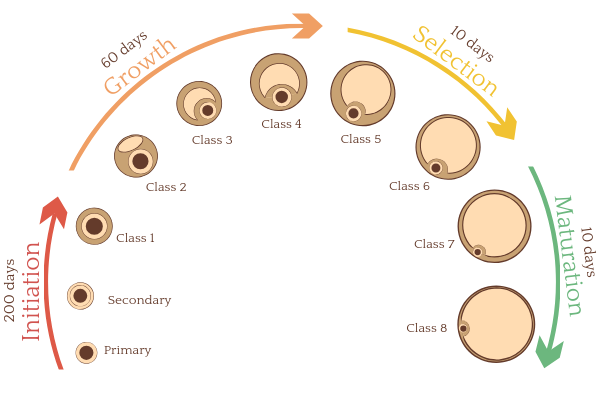
Inside our ovaries, our eggs are located inside what are called ovarian follicles. Each month, from puberty to menopause, a hormone called ‘follicular stimulating hormone’ is made in the brain which makes these follicles (and the eggs inside) grow and produce estrogen. This happens during the first half of a woman’s menstrual cycle, in preparation for ovulation.
The image below shows the maturation cycle of a typical female egg.
WHAT IS PERIMENOPAUSE?
Perimenopause is the years leading up to menopause, during which menstrual cycles because sporadic and unpredictable – but why?
The unpredictability is caused by the levels of estrogen in your body rising and falling unevenly. How unevenly you ask? Just take a look below.
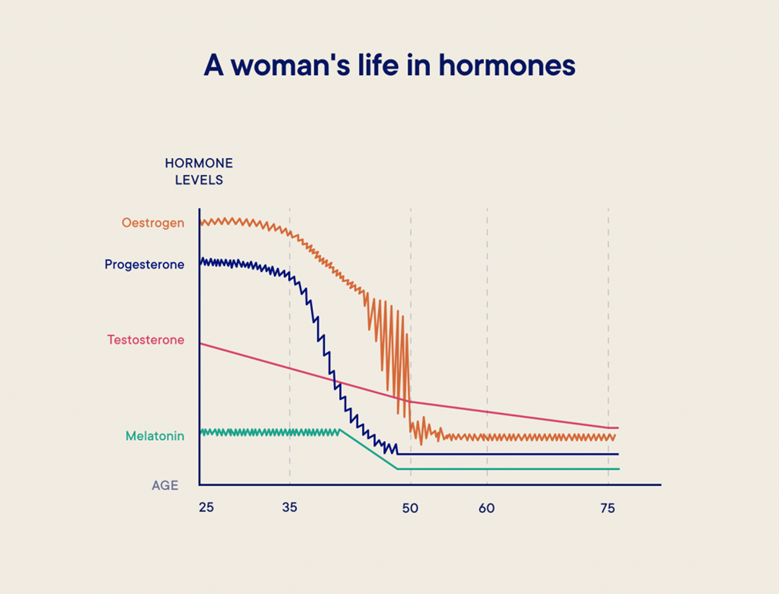
As is clear from the above graph, the few years before age 50 are a time of absolute upheaval. Welcome to perimenopause.
Because our warehouse of eggs is depleting, over time, fewer and fewer ovarian follicles remain to be stimulated. Because it is the ovarian follicles that produce estrogen, fewer ovarian follicles means decreasing levels of estrogen.
During perimenopause, women experience both decreasing levels of estrogen but also random spikes in estrogen, as shown above, hence the unpredictability.
Periods get longer, shorter, heavier, lighter, or all of the above. Breakthrough bleeding is another result of these estrogen spikes. Some periods don’t even result in ovulation at all. One thing is for sure, it is a very frustrating time.
THE TRANSITION TO MENOPAUSE
As perimenopause transitions to menopause (defined as no egg being released for at least 12 consecutive months) our remaining eggs become more resistant to the follicle-stimulating hormone. This leads to the ovaries dramatically reducing their production of estrogen and eventually, menstruation stops altogether.
SYMPTOMS OF MENOPAUSE
Almost all of the symptoms associated with perimenopause and menopause are believed to be caused by the loss of estrogen.
This makes sense given that estrogen affects many parts of the body, including the blood vessels, heart, bone, breasts, uterus, urinary system, skin, and brain.
I think many of us didn’t really appreciate all the estrogen we had during the decades we had plenty – if only we knew!
PHYSICAL CHANGES
Here are some physical changes associated with these lower levels of estrogen in your body.
Menstruation stops: One of the most defining characteristics of menopause is the cessation of menstruation.
Hot flashes & Night Sweats: Research suggests that hot flashes are just your body’s overreaction to a change in temperature and a misguided attempt to cool you down. Decreased estrogen levels cause your body’s thermostat (aka the hypothalamus) to become more sensitive to slight changes in body temperature. So when the hypothalamus thinks your body is too warm, it creates the hot flash because this then leads to sweat which will cool you down.
Mood swings and Cognitive Changes: Some women may experience emotional and cognitive changes during menopause. These can include mood swings, anxiety, and difficulties with memory and concentration. While not universal, these changes can have a significant impact on a woman’s quality of life.
Vaginal dryness: Declining estrogen levels cause vaginal tissues to become thinner and produce less natural lubrication.
Decreasing Bone Density: This can potentially leading to osteoporosis.
Changes in Reproductive Organs: The uterus and cervix may shrink in size, and the vaginal lining may become thinner and less elastic. These changes can contribute to discomfort during sexual intercourse and an increased risk of urinary tract infections.
Weight gain: This occurs particularly around the abdomen, which is due to the build up of visceral fat (not subcutaneous fat). Visceral fat is fat that lies deep within your abdominal organs and can’t be seen from the outside. It surrounds your stomach, liver, intestines, and other important organs, and as such, is quite dangerous. Subcutaneous fat is the fat just under your skin.
Reduced muscle mass: Declining estrogen levels contribute to reduced muscle maintenance and repair, accelerating age-related muscle loss.
Decrease in metabolism: Metabolism can decrease during menopause because declining estrogen levels contribute to muscle loss, as mentioned above, reducing the amount of energy the body burns at rest.
THE MYTH & MADNESS OF MENOPAUSE
In ancient times, menopause was shrouded in myth and mystery and frequently associated with supernatural or spiritual beliefs. It was viewed through a lens of fear and negativity, and linked to notions of impurity, loss of fertility, and even punishment.
But wait, it gets worse!
Unsurprisingly, the medieval times and Middle Ages brought along its own style of crazy. Menopause began being associated with witchcraft or demonic influences, and physical symptoms as innocuous as hot flashes led to women being accused of being witches.
Thankfully, the 19th and early 20th centuries brought along advances in medical knowledge, and finally menopause began to be better understood. It is at this time that menopause began being referred to as the ‘change of life’ – meaning the change from a childbearing life to a non-childbearing life.
As a GenXer who doesn’t define her life in terms of her ability to conceive, I’ll admit the term ‘change of life’ makes my skin crawl, but maybe that’s just me.
As medical science advanced, menopause came to be viewed as a natural part of a woman’s life. Research on hormonal changes and their impact on menopausal symptoms increased, leading to the development of treatments like Hormone Replacement Therapy (HRT), which we’ll discuss below.
HORMONE REPLACEMENT THERAPY (HRT)
Now that we’ve learned that decreasing levels of estrogen are basically at the root of all negative menopausal changes, it only makes sense that replacing this estrogen would alleviate the symptoms of menopause. HRT involves supplementing the body with hormones, primarily estrogen and sometimes progesterone, in various forms, including pills, patches, creams, and gels.
ADVANTAGES OF HRT
Symptom Relief: HRT is highly effective at relieving many menopausal symptoms, including hot flashes, night sweats, vaginal dryness, and mood swings. It can significantly improve a woman’s quality of life during this transitional period.
Bone Health: Estrogen plays a crucial role in maintaining bone density. HRT can help prevent or slow down the development of osteoporosis, reducing the risk of fractures.
Heart Health: Some studies suggest that HRT may have a protective effect on the cardiovascular system by maintaining healthy cholesterol levels and reducing the risk of heart disease in younger menopausal women.
CONSIDER HORMONE REPLACEMENT THERAPY
In a now widely discredited 2002 study, a link between HRT and an increase in breast cancer risk was reported. This announcement caused a significant number of women to stop taking HRT even though it was the only effective treatment for severe and troubling menopausal symptoms.
Fifteen years on, in 2017, it was reported that a principal investigator of the landmark women’s health study said that initial results that linked hormone replacement therapy (HRT) to breast cancer and heart attacks were misleading and distorted for publicity.
Because of bad science and a desire for a good headline, a generation of women abandoned HRT due to reported risks of a breast cancer link. It is appalling.
If the effects of menopause are negatively affecting your life, speak to a healthcare professional who is familiar with recent advancements in menopause care.
THE NEXT CHAPTER
Today, many of us will live decades as post-menopausal women, so let’s enjoy it. This chapter of our lives offers new opportunities to discover what brings us joy and make time for ourselves – without monthly periods, hoooray! We can embrace change with curiosity, confidence, and kindness toward our bodies. By sharing our experiences and supporting one another, we can feel more connected and empowered. There is still so much to explore, celebrate, and look forward to.